Orion 12" Truss Tube f/8 Ritchey Chretien Reflecting OTA Telescope
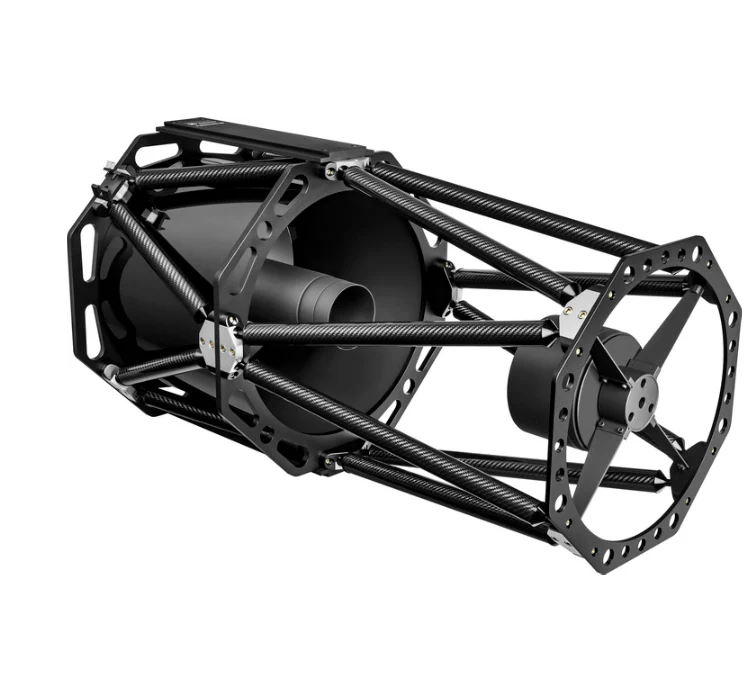
Unlike Newtonian reflector and Schmidt-Cassegrain designs that are susceptible to coma away from the center of the field, the Orion 12" f/8 Truss Tube Ritchey-Chrétien Astrograph utilizes hyperbolic primary & secondary mirrors to achieve wonderfully flat images that are virtually coma-free. Since there are no lenses involved, images are also free of chromatic aberration, showing off true color. Both the 12" primary mirror and the secondary mirror are made of low-expansion quartz glass. With enhanced aluminum coatings, the mirrors provide 96% reflectivity. The primary mirror is fixed in place to eliminate image shift that plagues Schmidt- and Maksutov-Cassegrain designs. The secondary mirror is precisely center-marked for easly collimation.
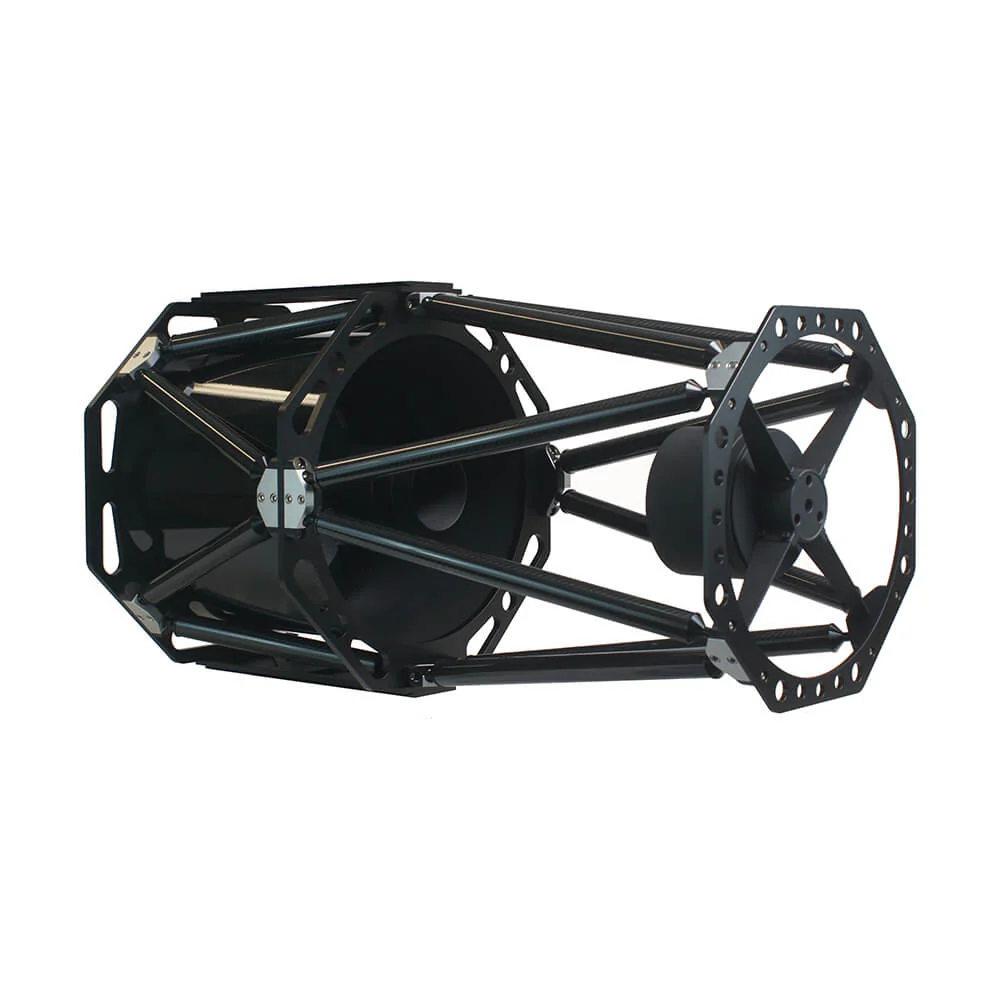
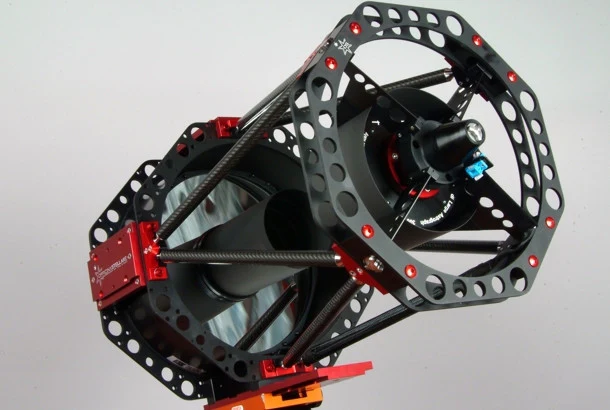
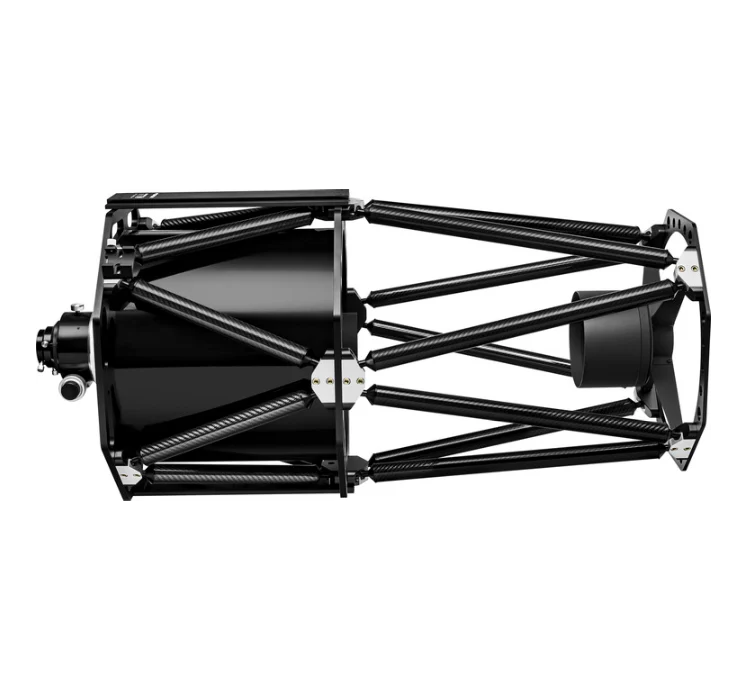
The carbon fiber truss system is thermally stable, minimizing the effect of ambient temperature changes on the telescope's focus. Plus, since it's an open tube, the optics cool down faster than solid tube versions. The Serrurier system utilizes two sets of opposing truss tubes on either side of the declination pivot plane, which keep the optical elements parallel to each other no matter how the telescope is oriented, thus keeping optical collimation precisely intact. Stainless steel ball and socket hardware connects the truss tubes to the telescope's three large CNC-machined aluminum support plates.
The focuser is a CNC-machined 3.3" dual-speed (10:1) linear bearing Crayford focuser features a stainless steel rail on the drawtube that provides extra support up to 9 lbs. of imaging gear without flexure or slippage. The focuser can be rotated 360º for image framing. Both 2" and 1.25" non-marring compression ring accessory collars permit the use of 2" or 1.25" accessories.
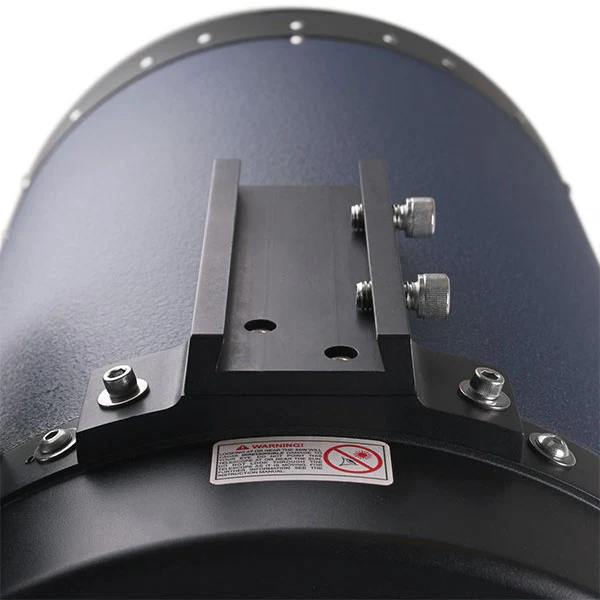
The Orion 12" f/8 Truss Tube Ritchey-Chrétien Astrograph tube assembly is equipped with a D-style dovetail mounting bar on both the bottom and top. A dovetail finder scope base is also installed for attachment of any finder scope (sold separately). Three 1.5" 12V DC cooling fans are mounted on the rear cell to help accelerate optical equilibration to ambient temperature. A battery holder is included (requires eight user-supplied AA batteries), as are one 2" and two 1" threaded extension rings for use in reaching focus with various configurations of imaging cameras and accessories. Primary and secondary mirror dust covers are also provided. Weighing 52 lbs. without any additional accessories, this telescope requires an equatorial mount that can support that load.
Superb optics, superior design, and sensational affordability come together to make the Orion 12" f/8 Truss Tube Ritchey-Chrétien Astrograph one spectacular instrument for capturing bright, detailed images of deep-space objects with CCD cameras and APS-C and full frame DSLRs.
The carbon fiber truss system is thermally stable, minimizing the effect of ambient temperature changes on the telescope's focus. Plus, since it's an open tube, the optics cool down faster than solid tube versions. The Serrurier system utilizes two sets of opposing truss tubes on either side of the declination pivot plane, which keep the optical elements parallel to each other no matter how the telescope is oriented, thus keeping optical collimation precisely intact. Stainless steel ball and socket hardware connects the truss tubes to the telescope's three large CNC-machined aluminum support plates.
The focuser is a CNC-machined 3.3" dual-speed (10:1) linear bearing Crayford focuser features a stainless steel rail on the drawtube that provides extra support up to 9 lbs. of imaging gear without flexure or slippage. The focuser can be rotated 360º for image framing. Both 2" and 1.25" non-marring compression ring accessory collars permit the use of 2" or 1.25" accessories.
The Orion 12" f/8 Truss Tube Ritchey-Chrétien Astrograph tube assembly is equipped with a D-style dovetail mounting bar on both the bottom and top. A dovetail finder scope base is also installed for attachment of any finder scope (sold separately). Three 1.5" 12V DC cooling fans are mounted on the rear cell to help accelerate optical equilibration to ambient temperature. A battery holder is included (requires eight user-supplied AA batteries), as are one 2" and two 1" threaded extension rings for use in reaching focus with various configurations of imaging cameras and accessories. Primary and secondary mirror dust covers are also provided. Weighing 52 lbs. without any additional accessories, this telescope requires an equatorial mount that can support that load.
Superb optics, superior design, and sensational affordability come together to make the Orion 12" f/8 Truss Tube Ritchey-Chrétien Astrograph one spectacular instrument for capturing bright, detailed images of deep-space objects with CCD cameras and APS-C and full frame DSLRs.
$1,575.00
Original: $4,499.99
-65%Orion 12" Truss Tube f/8 Ritchey Chretien Reflecting OTA Telescope—
$4,499.99
$1,575.00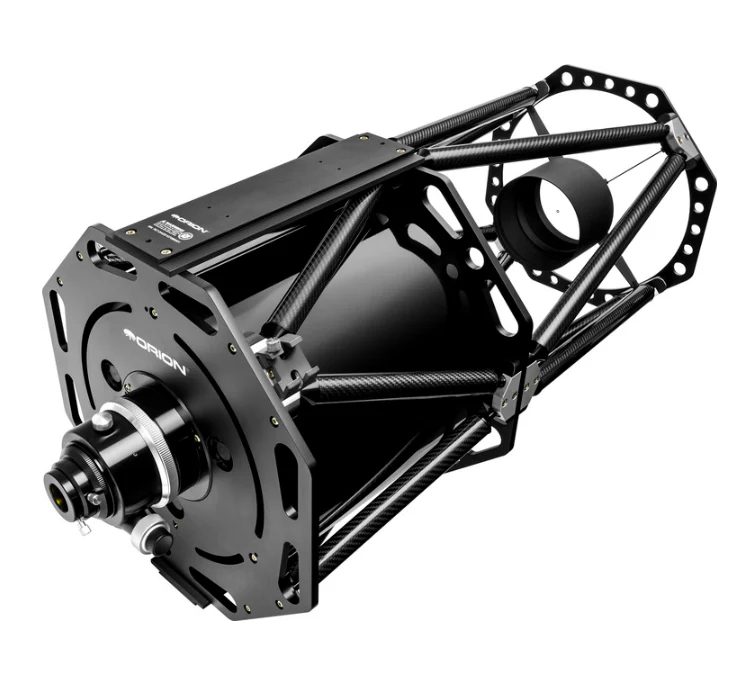
Description
Unlike Newtonian reflector and Schmidt-Cassegrain designs that are susceptible to coma away from the center of the field, the Orion 12" f/8 Truss Tube Ritchey-Chrétien Astrograph utilizes hyperbolic primary & secondary mirrors to achieve wonderfully flat images that are virtually coma-free. Since there are no lenses involved, images are also free of chromatic aberration, showing off true color. Both the 12" primary mirror and the secondary mirror are made of low-expansion quartz glass. With enhanced aluminum coatings, the mirrors provide 96% reflectivity. The primary mirror is fixed in place to eliminate image shift that plagues Schmidt- and Maksutov-Cassegrain designs. The secondary mirror is precisely center-marked for easly collimation.
The carbon fiber truss system is thermally stable, minimizing the effect of ambient temperature changes on the telescope's focus. Plus, since it's an open tube, the optics cool down faster than solid tube versions. The Serrurier system utilizes two sets of opposing truss tubes on either side of the declination pivot plane, which keep the optical elements parallel to each other no matter how the telescope is oriented, thus keeping optical collimation precisely intact. Stainless steel ball and socket hardware connects the truss tubes to the telescope's three large CNC-machined aluminum support plates.
The focuser is a CNC-machined 3.3" dual-speed (10:1) linear bearing Crayford focuser features a stainless steel rail on the drawtube that provides extra support up to 9 lbs. of imaging gear without flexure or slippage. The focuser can be rotated 360º for image framing. Both 2" and 1.25" non-marring compression ring accessory collars permit the use of 2" or 1.25" accessories.
The Orion 12" f/8 Truss Tube Ritchey-Chrétien Astrograph tube assembly is equipped with a D-style dovetail mounting bar on both the bottom and top. A dovetail finder scope base is also installed for attachment of any finder scope (sold separately). Three 1.5" 12V DC cooling fans are mounted on the rear cell to help accelerate optical equilibration to ambient temperature. A battery holder is included (requires eight user-supplied AA batteries), as are one 2" and two 1" threaded extension rings for use in reaching focus with various configurations of imaging cameras and accessories. Primary and secondary mirror dust covers are also provided. Weighing 52 lbs. without any additional accessories, this telescope requires an equatorial mount that can support that load.
Superb optics, superior design, and sensational affordability come together to make the Orion 12" f/8 Truss Tube Ritchey-Chrétien Astrograph one spectacular instrument for capturing bright, detailed images of deep-space objects with CCD cameras and APS-C and full frame DSLRs.
The carbon fiber truss system is thermally stable, minimizing the effect of ambient temperature changes on the telescope's focus. Plus, since it's an open tube, the optics cool down faster than solid tube versions. The Serrurier system utilizes two sets of opposing truss tubes on either side of the declination pivot plane, which keep the optical elements parallel to each other no matter how the telescope is oriented, thus keeping optical collimation precisely intact. Stainless steel ball and socket hardware connects the truss tubes to the telescope's three large CNC-machined aluminum support plates.
The focuser is a CNC-machined 3.3" dual-speed (10:1) linear bearing Crayford focuser features a stainless steel rail on the drawtube that provides extra support up to 9 lbs. of imaging gear without flexure or slippage. The focuser can be rotated 360º for image framing. Both 2" and 1.25" non-marring compression ring accessory collars permit the use of 2" or 1.25" accessories.
The Orion 12" f/8 Truss Tube Ritchey-Chrétien Astrograph tube assembly is equipped with a D-style dovetail mounting bar on both the bottom and top. A dovetail finder scope base is also installed for attachment of any finder scope (sold separately). Three 1.5" 12V DC cooling fans are mounted on the rear cell to help accelerate optical equilibration to ambient temperature. A battery holder is included (requires eight user-supplied AA batteries), as are one 2" and two 1" threaded extension rings for use in reaching focus with various configurations of imaging cameras and accessories. Primary and secondary mirror dust covers are also provided. Weighing 52 lbs. without any additional accessories, this telescope requires an equatorial mount that can support that load.
Superb optics, superior design, and sensational affordability come together to make the Orion 12" f/8 Truss Tube Ritchey-Chrétien Astrograph one spectacular instrument for capturing bright, detailed images of deep-space objects with CCD cameras and APS-C and full frame DSLRs.